
NXP i.MX 8M Plus vs i.MX 93: CPU, NPU, Power, and Software Compared
Compare NXP i.MX 8M Plus vs i.MX 93 for industrial products, including CPU, NPU, power strategy, display, interfaces, BSP support, and lifecycle.
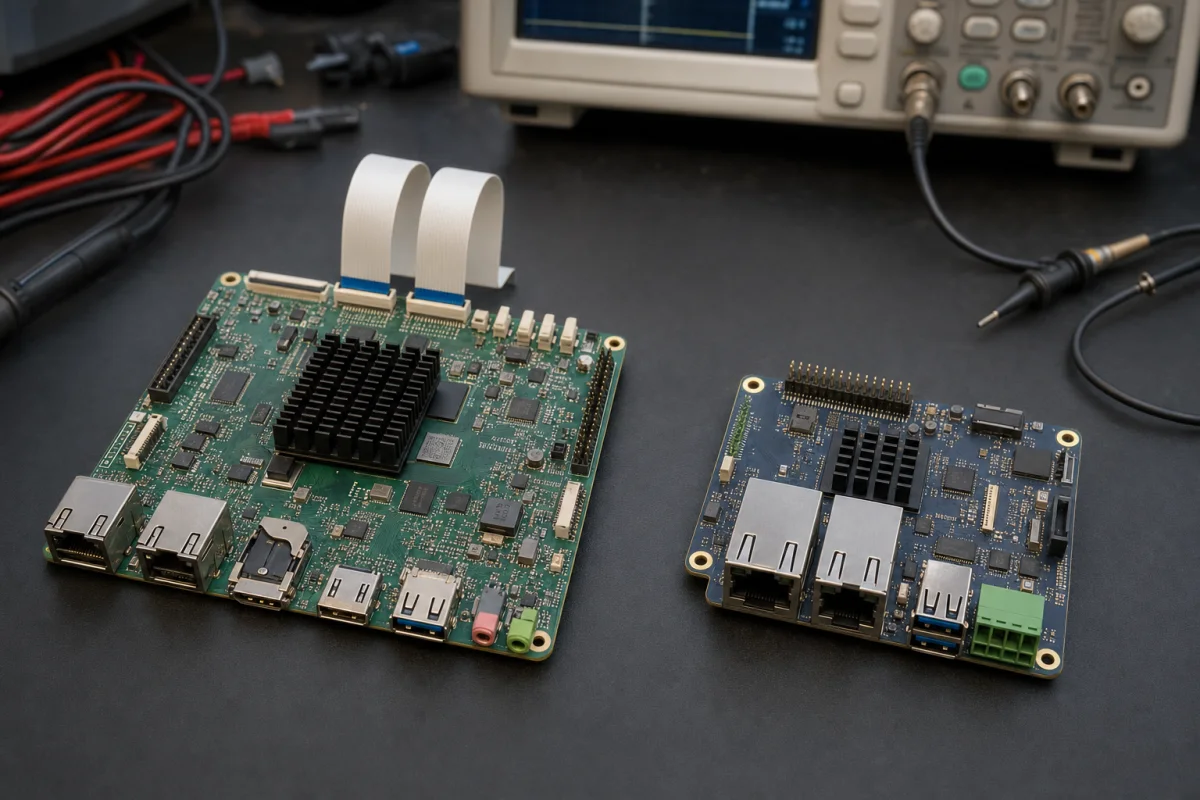
A customer recently asked us whether the i.MX 93 was the “new replacement” for the i.MX 8M Plus. It is an understandable question. The part number is newer, the CPU architecture moves from Cortex-A53 to Cortex-A55, and both devices target industrial edge products.
But treating the i.MX 93 as a faster i.MX 8M Plus leads to a bad shortlist.
The i.MX 8M Plus vs i.MX 93 decision is really a choice between two system shapes. The i.MX 8M Plus is the more capable multimedia and vision processor: four application cores, a 3D GPU, video codecs, dual image signal processors, and a 2.3-TOPS NPU. The i.MX 93 is a leaner industrial processor built around two newer CPU cores, a Cortex-M33 real-time domain, efficient machine learning, dual Ethernet, CAN FD, and an EdgeLock secure enclave.
If the product needs Android, multiple cameras, 3D graphics, or heavier vision inference, we normally start with the i.MX 8M Plus. If it needs a compact Linux platform, modest 2D HMI, deterministic peripheral handling, and careful power management, the i.MX 93 deserves the first prototype.
The Short Comparison
The table below uses SoC capabilities, not the connectors found on a particular evaluation kit or commercial SBC. Pin multiplexing and package variants still need to be checked against the selected ordering code.
| Design area | i.MX 8M Plus | i.MX 93 | What changes in the product |
|---|---|---|---|
| Application CPU | 4× Cortex-A53, up to 1.8 GHz | 2× Cortex-A55, up to 1.7 GHz | i.MX 93 has newer cores; i.MX 8M Plus has more application cores |
| Real-time core | Cortex-M7, up to 800 MHz | Cortex-M33, up to 250 MHz | M7 offers more raw MCU performance; M33 belongs to a newer security-aware architecture |
| DSP | HiFi 4 DSP, up to 800 MHz | No equivalent HiFi 4 block | i.MX 8M Plus is stronger for dedicated audio/voice processing |
| Machine learning | NPU rated up to 2.3 TOPS | Ethos-U65 microNPU, 256 MAC/cycle | Do not compare these figures as if they were the same benchmark |
| External memory | 32-bit LPDDR4/DDR4 with inline ECC support | 16-bit LPDDR4/LPDDR4X, up to 3.7 GT/s, with inline ECC | i.MX 93 reduces memory-bus width and board complexity; i.MX 8M Plus has more bandwidth headroom |
| Graphics | 3D and 2D GPUs | 2D GPU/hardware compositor | Rich 3D UI favors i.MX 8M Plus |
| Camera and ISP | 2× MIPI CSI; dual ISP up to 12 MP | 1× 2-lane MIPI CSI up to 1080p60; no comparable dual-ISP subsystem | Multi-camera vision favors i.MX 8M Plus |
| Display | HDMI 2.0a, MIPI DSI, LVDS | 1080p60 MIPI DSI, 720p60 LVDS, parallel RGB | i.MX 93 fits restrained HMI; i.MX 8M Plus fits richer display products |
| Industrial networking | 2× GbE, one with TSN; 2× CAN FD | 2× GbE, one with TSN; 2× CAN FD | Both can support a two-network industrial gateway |
| USB | USB 3-class connectivity available | USB 2.0 | High-throughput USB peripherals favor i.MX 8M Plus |
| Security architecture | CAAM, TrustZone, secure boot building blocks | EdgeLock secure enclave plus TrustZone | i.MX 93 provides a newer isolated security subsystem |
| NXP-listed OS support | Linux, Android, FreeRTOS | Linux, FreeRTOS, and partner RTOS options | Official Android support is a major divider |
This is not a winner-takes-all table. It shows why swapping one part for the other changes the whole architecture.
CPU Performance: Four Older Cores or Two Newer Ones?
Cortex-A55 improves efficiency and per-clock behavior over Cortex-A53, but core generation is only half the story. The i.MX 8M Plus has four application cores. The i.MX 93 commonly has two.
That difference is visible when the workload contains several substantial Linux processes: a browser-based UI, video pipeline, local database, container runtime, and cloud agent running together. Four A53 cores give the scheduler more room. The i.MX 8M Plus also carries hardware blocks that prevent video, graphics, audio, and vision work from falling back onto the CPU.
The i.MX 93 can feel very responsive in the job it was designed for. A Qt dashboard, protocol gateway, security agent, and moderate inference task are reasonable. A Chromium UI with animated layers, multiple 1080p streams, and background analytics is a different proposition. We would not approve that design from a CPU comparison alone; we would put the actual application on the EVK and watch CPU residency, memory bandwidth, frame time, and thermal behavior for several hours.
The real-time cores also serve different needs. The i.MX 8M Plus Cortex-M7 runs at a much higher maximum clock and is useful for fast local processing or low-latency tasks. The i.MX 93 Cortex-M33 is slower on paper, but its domain is central to the i.MX 93 concept: Linux handles networking, storage, UI, and management while the M33 handles a bounded set of peripheral and timing-sensitive functions. Neither arrangement makes Linux itself deterministic.
NPU and Vision: The Numbers Are Not Directly Comparable
The i.MX 8M Plus NPU is rated at 2.3 TOPS. The i.MX 93 integrates Arm’s Ethos-U65 at 256 multiply-accumulate operations per cycle. Those are different descriptions of different accelerators. Converting one number into the other and declaring a percentage win is not sound engineering.
For camera-based inspection, the i.MX 8M Plus has a wider system advantage than the NPU figure suggests. It combines two camera inputs, dual ISPs, hardware video processing, a larger memory interface, and the NPU. A pipeline that captures two sensors, performs demosaic and exposure work, runs detection, overlays results, and records video is much closer to its intended use.
The i.MX 93 makes sense for smaller models and intermittent inference: wake-word detection, simple image classification, anomaly detection from sensor data, people counting at moderate resolution, or a compact scanner. It can run useful ML without turning the board into a high-power vision computer.
We recommend testing the exported model early. Operator support, quantization, pre-processing cost, memory movement, and camera conversion can dominate the result. “NPU supported” does not mean the complete pipeline stays on the accelerator. NXP’s eIQ tools support both platforms, but the backends and model constraints differ.
Power: Measure the Board, Not a Marketing Number
There is no honest single watt figure for either SoC that can size an enclosure. Board memory, PMIC efficiency, Ethernet PHYs, radios, display backlight, USB loads, camera sensors, workload, and ambient temperature all change the result.
Architecturally, the i.MX 93 has several reasons to be the lower-power starting point: two application cores, a 16-bit memory interface, Energy Flex domains, and less multimedia hardware. That advantage can disappear if software prevents low-power states, both Ethernet ports run continuously, or a bright display dominates the system budget.
For a production comparison, we use the same workload and record at least these conditions:
| Test point | What to run | What it exposes |
|---|---|---|
| Boot peak | Cold boot from production storage | PMIC margin and peak input sizing |
| Linux idle | Services running, display off and radios associated | Baseline leakage and power-state configuration |
| HMI active | Target display brightness and real UI animation | GPU/compositor and DDR activity |
| Network load | Both Ethernet ports passing representative traffic | PHY and packet-processing cost |
| ML workload | Production model at required inference rate | Accelerator utilization and thermal rise |
| Worst credible case | HMI, networking, inference, and storage together | Enclosure temperature and throttling margin |
Log input power and the SoC thermal sensors until the temperatures settle. A five-minute demo tells us very little about a sealed panel expected to run for ten years.
Display, Camera, and Board Complexity
For an HMI with one 7-inch or 10.1-inch panel, the i.MX 93 display subsystem may be entirely sufficient. It supports MIPI DSI, LVDS, and parallel RGB, but its published limits need to be matched to the exact panel timing. “LVDS supported” is not enough; 720p60-class LVDS can rule out a panel that a buyer selected by physical size alone.
The i.MX 8M Plus gives the carrier-board designer more multimedia options, including HDMI 2.0a and a stronger camera path. It also brings a larger BGA, a wider memory bus, more high-speed routing, and usually more software surface area. That can increase PCB layers and validation effort.
The i.MX 93’s 16-bit LPDDR4/LPDDR4X interface and smaller package options can simplify a compact custom board. This is valuable when the product needs dual Ethernet, CAN FD, eMMC, a modest display, and no high-end video. Simpler is not automatically cheaper—the security provisioning flow and M33 firmware still require engineering—but the hardware is better aligned with the workload.
The same trade-offs appear across NXP Android boards, while an NXP vs Rockchip shortlist adds lifecycle and BSP risk.
Software Support May Decide Before Hardware Does
At the time of writing, NXP lists an official Android 16 BSP for the i.MX 8M Plus EVK. NXP’s i.MX 93 product material lists Linux, FreeRTOS, and commercial RTOS options, not an equivalent production Android offering. That makes the answer straightforward for many Android projects: use the i.MX 8M Plus or choose another processor with a supported Android path.
For Linux products, both devices benefit from NXP’s Yocto-based i.MX BSP. The i.MX 93 is especially attractive when the architecture deliberately splits Linux and real-time firmware. That split must be designed, not assumed. Define which core owns each peripheral, how messages are passed, what happens when Linux restarts, how M33 firmware is updated, and how logs from both domains are collected.
Security also affects software architecture. The i.MX 93 EdgeLock secure enclave can support a stronger isolated root of trust, but the feature creates value only when production uses signed boot artifacts, protected keys, controlled debug access, authenticated updates, and a documented recovery path. Leaving development keys in the factory image wastes the hardware.
Which One Should You Choose?
| Product requirement | Better starting point | Reason |
|---|---|---|
| Android HMI or Android smart terminal | i.MX 8M Plus | Official Android enablement and stronger graphics/multimedia |
| Dual-camera inspection or vision gateway | i.MX 8M Plus | Dual CSI, dual ISP, higher-throughput NPU |
| Rich 3D UI or HDMI product | i.MX 8M Plus | 3D GPU and HDMI 2.0a |
| Compact Linux gateway with dual Ethernet | i.MX 93 | Efficient CPU/memory architecture and strong networking |
| Linux HMI plus bounded real-time I/O | i.MX 93 | Cortex-M33 and peripheral-rich industrial architecture |
| Security-centered connected device | i.MX 93 | EdgeLock secure enclave |
| High-throughput USB peripheral | i.MX 8M Plus | USB 3-class capability |
| Lowest board complexity for a modest UI | i.MX 93 | Narrower memory bus and smaller package options |
Do not select from this matrix alone. Freeze the display, camera count, OS, ML model, Ethernet topology, industrial I/O, and update policy first. Then build a two-week risk prototype around the uncertain item. For i.MX 8M Plus, that is often camera and inference throughput. For i.MX 93, it is often UI performance, Linux/M33 ownership, or low-power-state behavior.
The practical answer is simple: choose i.MX 8M Plus when multimedia is part of the product’s core value. Choose an i.MX 93 industrial SBC when the product is a controller or gateway that happens to need a screen and some local intelligence. That distinction is much more useful than asking which chip is newer.
Official References
Frequently Asked Questions
Is i.MX 93 faster than i.MX 8M Plus?
Not across the board. The i.MX 93 has newer Cortex-A55 CPU cores, but only two of them. The i.MX 8M Plus has four Cortex-A53 cores, stronger multimedia hardware, a 3D GPU, dual ISPs, and a higher-throughput NPU for many vision workloads.
Which processor is better for an industrial HMI?
Choose i.MX 8M Plus for richer graphics, Android, video, multiple cameras, or vision AI. Choose i.MX 93 for a lean Linux HMI or gateway where power efficiency, security, dual Ethernet, CAN FD, and real-time MCU work matter more than 3D graphics.
Does i.MX 93 support Android?
NXP’s current i.MX 93 product page lists Linux and real-time operating systems, while NXP provides an official Android BSP for the i.MX 8M Plus EVK. A third-party i.MX 93 Android image should be treated as vendor-specific support and audited separately.
Can i.MX 93 replace i.MX 8M Plus on an existing board?
No. They are not pin-compatible drop-in replacements. A migration requires a new PCB, PMIC and memory review, display and camera rework, and a fresh BSP validation plan.