
Industrial SBC vs Raspberry Pi: What Changes When You Move to Mass Production?
Compare an industrial SBC vs Raspberry Pi for production, including storage, power, connectors, temperature, compliance, lifecycle, testing, and support.
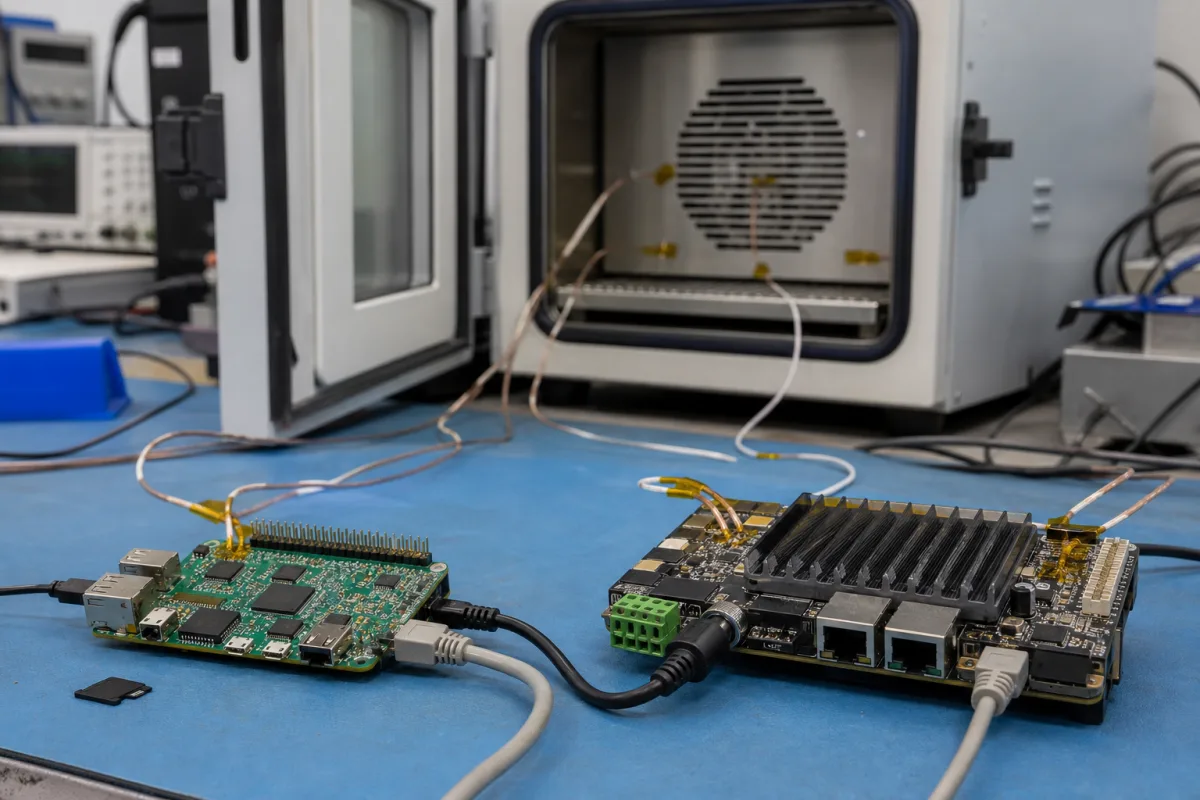
The first prototype often starts with a Raspberry Pi because one is already on an engineer’s desk. The application boots quickly, Linux packages are familiar, and a standard monitor and USB touch panel work without a custom cable. That is good engineering: learn about the product before spending money on hardware.
Trouble starts when a successful prototype is copied directly into a sealed enclosure and called production-ready. The industrial SBC vs Raspberry Pi decision is not a contest between a “professional” board and a “hobby” board. Raspberry Pi supports a large industrial customer base, publishes compliance material, and makes long manufacturing commitments. The real comparison is between two specific system designs, including storage, power input, carrier hardware, OS image, thermal path, test coverage, and supply agreement.
Mass production changes the questions. Can every unit be flashed and traced? What happens during a brownout? Will the cable stay connected after vibration? Can software updates be reproduced five years later? Those answers matter more than the logo on the board.
The Practical Differences
The table describes common tendencies, not guarantees. Some industrial SBCs are little more than development boards with a wider input connector. Some Raspberry Pi-based products are thoroughly engineered.
| Design area | Raspberry Pi computer | Typical industrial SBC | Production consequence |
|---|---|---|---|
| Primary storage | Often removable microSD; model-dependent alternatives | Soldered eMMC is common | Different endurance, service, and image-loading strategy |
| Power input | Consumer-style 5 V input on many models | 9–36 V or similar protected input may be offered | External conversion and transient protection may move on or off the board |
| Connectors | HDMI, USB, pin headers | Locking terminals, JST/Molex-style headers, industrial I/O | Cable retention and harness cost change |
| Serial/fieldbus | GPIO header and adapters | RS485, CAN, isolated I/O may be integrated | Fewer adapters, but driver and protection still need review |
| Temperature | Published per product; system cooling required | Commercial or industrial-temperature variants | Whole assembly must still be tested at temperature |
| Hardware changes | Raspberry Pi publishes lifecycle and product notices | Depends heavily on vendor change policy | Contract evidence is more useful than category labels |
| Software | Large community and Raspberry Pi OS ecosystem | Vendor Linux/Android BSP, sometimes smaller community | Ownership and update path differ |
| Compliance evidence | Extensive product portal and integration support | Varies from reports to unsupported claims | Final product remains a separate compliance task |
| Production services | Official integrator and industry programs available | Custom flashing, fixtures, PCN, RMA may be bundled | Verify the actual service scope |
A Raspberry Pi may win several rows for a given product. An industrial SBC label does not earn points by itself.
Storage and Power Failures Appear First
Development systems are shut down politely. Field systems lose power when an operator opens a breaker, a vehicle cranks, or a low-cost supply collapses. A writable filesystem on a removable microSD card can survive many events and then fail on the one event that occurs during metadata or database activity.
The answer is not simply “eMMC never fails.” eMMC also has finite endurance and can be corrupted by poor power behavior. Production design should control writes, rotate logs, monitor free space, test abrupt power removal across boot and update states, and define a recovery image. If the device records video, telemetry, or a local database, calculate write amplification using the actual application.
Power needs the same system treatment. A board specified for 5 V does not automatically tolerate reverse polarity, EFT, surge, slow ramp, or a long cable drop. Add a front end designed for the installation and verify peak current during boot and peripheral startup. Industrial SBCs often integrate this circuitry, which can save time, but ask for its operating and survival limits. “12 V input” is not a transient specification.
For 24/7 products, a hardware watchdog or external supervisor should recover a genuinely stuck system, and the software must prove it is healthy before feeding the watchdog. An unrelated timer thread can continue feeding while the useful application is deadlocked, providing false comfort.
Connectors and I/O Change the Assembly
Raspberry Pi’s full-size USB and HDMI connectors are excellent during development. They can be awkward behind a shallow display or inside a vibrating machine. Consumer plugs also consume enclosure volume and may need clips, adhesive, or custom brackets. Each adapter adds two connectors and another failure point.
An industrial SBC may expose display, touch, audio, power, CAN, and RS485 through locking headers. That reduces bulk, but it creates a harness drawing, crimp specification, assembly instruction, and service-spares requirement. Check mating cycles, keying, cable exit direction, and whether similar connectors can be swapped accidentally.
Fieldbus support has two layers. The transceiver and protection must suit the electrical environment; the operating system and application must have a stable interface. An onboard CAN transceiver is useful only when termination, isolation, bitrate, SocketCAN support, and restart behavior match the product. Our CAN implementation notes show why a connector count is not enough.
Temperature Is a System Test
For industrial SBC validation, distinguish ambient operating range, SoC junction limits, and component grades before comparing published temperatures. Storage, radio modules, oscillators, connectors, and displays can set a narrower system limit.
Raspberry Pi boards can be cooled and integrated into commercial equipment. An industrial SBC can also throttle or reset when placed behind a bright display in a sealed box. Test the final workload at the declared ambient temperature with the production enclosure, heat spreader, cables, and orientation. Record CPU frequency, temperatures, input power, application frame time, and errors until thermal equilibrium.
We also cycle power at cold and hot conditions. Marginal oscillators, storage timing, and regulators may pass a steady-state test yet fail during startup. Thermocouples on the SoC heat spreader, PMIC area, memory, and enclosure give better evidence than a single software sensor.
Lifecycle: Raspberry Pi Is Not the Weak Assumption
Raspberry Pi explicitly markets to industry and publishes minimum manufacturing lifetimes. Its September 2025 longevity statement gives Raspberry Pi 5 a guaranteed minimum manufacturing end date of January 2038. The organization also maintains a product information portal with compliance and product documentation.
That is stronger evidence than an unknown board vendor saying “ten-year supply” in an email. Still, the full product depends on the chosen board model, connectors, memory configuration, camera, radio, display, and accessories. Read the notice for the exact SKU and plan software maintenance as well as hardware purchase.
For an industrial SBC, ask for the SoC vendor’s longevity status, the board’s own last-time-buy policy, PCN notice period, approved memory and eMMC alternates, and rules for firmware changes. A processor with a long-life commitment does not guarantee the Wi-Fi module or board assembly.
An Android SBC supplier audit should test whether these promises are linked to controlled records and contract terms.
Software Ecosystem vs Product Ownership
Raspberry Pi OS has a large community, extensive packages, and familiar documentation. That is valuable when the product runs Linux and the team can maintain its application on the supported distribution. An industrial board may offer Yocto, Debian, Ubuntu, or Android with a smaller public community but direct access to board-specific engineering.
Android changes the balance. A generic claim that Android runs on the processor is not the same as a maintained production BSP with display tuning, HALs, SELinux policy, kiosk behavior, signed updates, and source delivery. If the product needs Android, compare actual release branches and support commitments rather than assuming a Raspberry Pi Linux prototype will translate directly.
In either case, freeze the image. Keep manifests, package versions, build instructions, configuration, licenses, signing material, and regression results. Pulling the latest packages from the internet during every factory build is not reproducible manufacturing.
Compliance and Production Test Still Belong to You
Raspberry Pi provides compliance documents and says its products are certified in more than 80 countries. It also offers integration support, including guidance for radio modules and antennas. This can reduce evidence-gathering and test risk. It does not mean that the finished product’s new enclosure, supply, display, cables, and antenna automatically inherit approval.
The same is true for an industrial SBC carrying CE or FCC marks. Get the underlying reports, model identifiers, test configurations, and integration conditions. Then have a qualified lab determine the final product route.
Production testing needs to be added around either platform. At minimum, identify the board and image revision, program serials and network addresses, exercise required ports, confirm storage, run a representative application test, and retain results by unit or lot. For a Raspberry Pi on a custom carrier, the carrier and complete assembly need their own fixture. For an industrial SBC, do not assume the supplier’s standard fixture tests your optional CAN channel, display cable, or radio configuration.
The Compute Module Is Often the Bridge
A Raspberry Pi Compute Module separates the compute core from the application carrier. The carrier can implement locking connectors, protected power, exact display routing, required I/O, and product mechanics without redesigning the processor and memory section. This is often a sensible production path when the Raspberry Pi software ecosystem is a strong fit but the standard computer is mechanically awkward.
The trade is new carrier-board NRE and validation. High-speed routing, power design, antenna choices, thermal mechanics, and compliance remain. The distinction between an SBC, SoM, and CoM helps place that work at the right architectural boundary.
Choose from Failure Modes
Use Raspberry Pi when its software ecosystem, published lifecycle, availability, and price fit the product, and when your team is prepared to engineer the surrounding power, storage, mechanics, and test process. Consider a Compute Module when the platform fits but the board form factor does not.
Choose an industrial SBC when integrated eMMC, protected wide-input power, locking connectors, CAN/RS485, a specific Android BSP, or supplier-managed customization removes meaningful system work. Then verify every industrial claim with a drawing, report, test, or contract term.
Build ten or twenty complete units before making the architecture permanent. Give them to the production operator, thermal chamber, EMC bench, software updater, and service technician. The board that creates fewer uncontrolled failure modes in those hands is the better production platform.
Official References
Frequently Asked Questions
Can Raspberry Pi be used in a commercial or industrial product?
Yes. Raspberry Pi is used in commercial products and has formal industrial, compliance, and longevity programs. The engineering question is whether the chosen board or Compute Module meets the product’s connector, storage, power, thermal, I/O, software, and service requirements.
What makes an industrial SBC different from a Raspberry Pi?
An industrial SBC usually prioritizes controlled revisions, embedded storage, protected power, locking connectors, industrial I/O, wider temperature options, watchdogs, production test records, and vendor BSP support. These features vary by model and must be verified.
Is a Raspberry Pi Compute Module better than a full Raspberry Pi board for production?
Often, yes. A Compute Module lets the product team design a carrier with suitable power, connectors, protection, and mechanics while retaining the Raspberry Pi compute platform. It adds carrier-board NRE and validation work.
Should an industrial product avoid microSD storage?
Removable microSD can be useful for development and service, but 24/7 products need a deliberate endurance and corruption strategy. Soldered eMMC, controlled logging, read-only partitions, power-fail handling, and validated update recovery are common production choices.