
How Much Does Custom SBC Design Cost? NRE, Tooling, and Certification Explained
Estimate custom SBC design cost with realistic NRE ranges for hardware, BSP work, prototypes, tooling, compliance testing, pilot builds, and redesign risk.
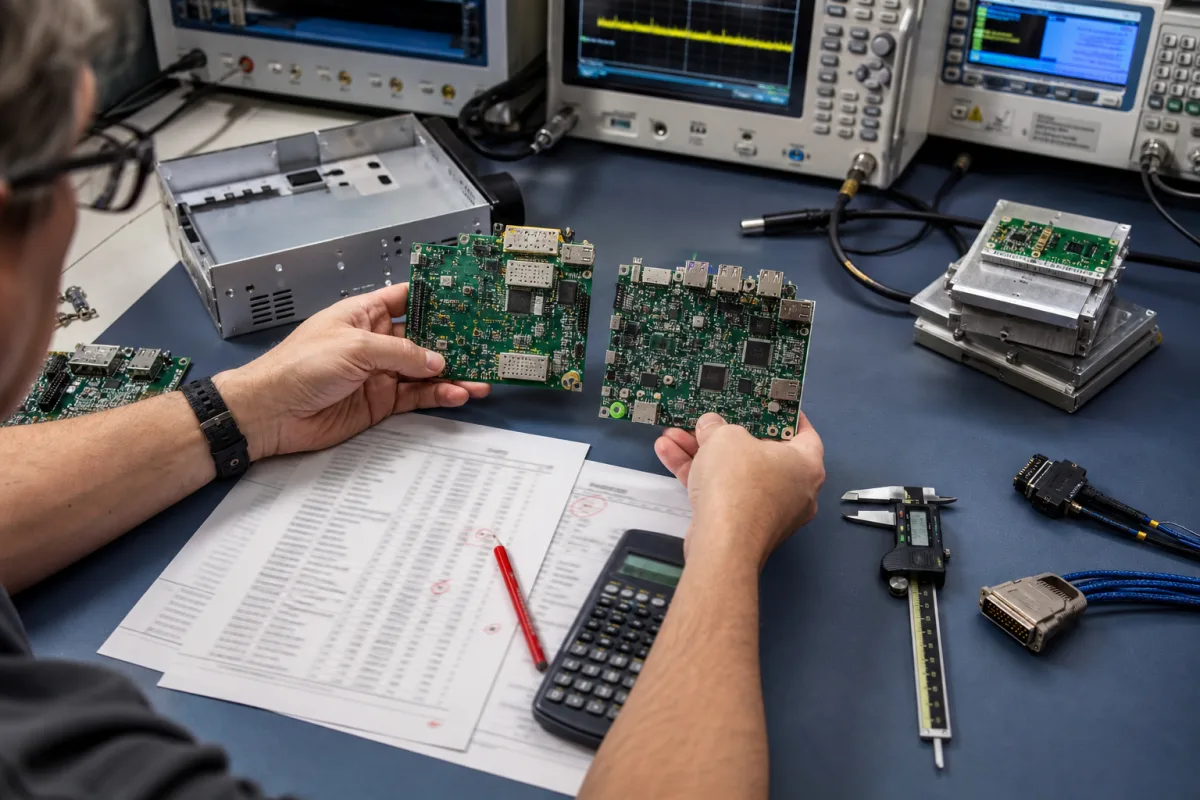
When a supplier quotes “$25,000 NRE” for a custom SBC and another quotes $140,000, the natural reaction is that one is expensive. Sometimes that is true. More often, the two quotes describe different jobs.
One may cover a connector change to a proven PCB and a few device-tree edits. The other may include a new six-layer board, DDR layout, two prototypes, Android BSP integration, a functional fixture, EMC troubleshooting, and production transfer. Until scope, assumptions, and acceptance tests are on the same page, the numbers cannot be compared.
For 2026 planning, a custom SBC design cost of $80,000–$250,000 or more is a defensible early range for a new ARM board intended for production. A custom carrier around a proven SoM can be roughly $35,000–$100,000. Simple changes to an existing SBC may be lower. These are budget ranges from typical embedded development scope, not a Silicore rate card or a promise that any particular design fits them.
Match the Budget to the Architecture
The biggest cost divider is how much proven circuitry is being reopened.
| Project type | What is usually designed | Early engineering budget | Main cost driver |
|---|---|---|---|
| Standard-board integration | Harness, mounting, image, minor accessories | $5k–$25k | System integration and software configuration |
| Existing-board modification | Connector, population, outline, firmware variant | $15k–$60k | Extent of changes and regression testing |
| Custom SoM carrier | Power input, I/O, display, connectors, mechanics | $35k–$100k | High-speed carrier I/O and product validation |
| Full custom ARM SBC | SoC, DDR, PMIC, storage, all I/O, BSP | $80k–$250k+ | Processor-board bring-up and software ownership |
| Complex vision or RF platform | Multi-camera, PCIe, radio, high bandwidth, custom mechanics | $150k–$400k+ | Signal integrity, thermal, RF, and specialist validation |
Reuse matters. A supplier that has already shipped the same SoC, PMIC, memory topology, and Android branch is not starting from a blank page. Ask which design blocks are copied without change, which are modified, and which are new. Then ask for evidence that the reused blocks passed the conditions your product needs.
The SBC, SoM, and CoM architecture choice often changes NRE more than removing a few connectors from the BOM.
What Hardware NRE Actually Buys
Hardware engineering begins before schematic capture. Requirements have to be converted into power trees, interfaces, pin multiplexing, mechanical constraints, test points, component grades, and safety or EMC assumptions. A missed requirement at this stage is cheap to write down and expensive to repair after layout.
For a full SBC, expect work in these areas:
- architecture, component selection, and supply review;
- schematic design and peer review;
- PCB stack-up, placement, impedance plan, and routing;
- DDR, MIPI, HDMI, USB, PCIe, and Ethernet constraints where used;
- power sequencing, reset, clock, boot-mode, and recovery design;
- thermal concept and mechanical coordination;
- prototype procurement, assembly support, and board bring-up;
- issue tracking, ECOs, and manufacturing release files.
Deliverables should include more than Gerbers. Define schematic source, PCB source or manufacturing data, BOM with approved manufacturers, fabrication and assembly drawings, stack-up, controlled-impedance requirements, mechanical model, bring-up record, known issues, and revision history. Ownership and transfer rights affect the price; settle them before the design exists.
A low NRE quote often assumes one PCB spin. That can be reasonable for a small modification and aggressive for a new processor board. Budget a corrective revision even if the team hopes not to use it. The contingency is cheaper than announcing a launch date that only works if every high-speed and power decision is correct first time.
Software Is a Separate Engineering Program
A board that reaches a bootloader prompt is not an Android product. Software cost can include bootloader adaptation, kernel and device tree, storage layout, display initialization, touch, camera, audio, Wi-Fi/Bluetooth, CAN or serial access, HALs, SELinux policy, factory flashing, signing, recovery, OTA, and application integration.
The cost depends heavily on the starting point:
| Software starting point | Relative effort | What to verify |
|---|---|---|
| Same SoC and nearly identical reference design | Lower | Drivers still match changed peripherals and display |
| Same SoC, new board and several peripherals | Medium | Pinmux, power, device tree, HAL, thermal and update behavior |
| New SoC family with vendor Android BSP | Medium to high | BSP maturity, Android version, source, vendor response |
| Community or unsupported Android port | High and uncertain | Missing acceleration, codecs, security patches, test coverage |
| GMS product | Additional commercial work | Compatibility, licensing, certification, update obligations |
Ask for a supported release, not merely a successful first image. The contract should state source deliverables, clean-build method, Android version, security patch policy, test scope, signing responsibility, issue severity, and maintenance period. Android’s compatibility program uses the CDD and CTS for compatible devices; GMS licensing is a later, separate consideration.
An Android BSP evaluation should happen before hardware is frozen because software gaps can force component changes.
Prototypes and Pilot Builds Are Not Unit Price
Prototype boards cost far more per unit than production boards. Fabrication setup, small-quantity component purchases, stencil, machine setup, X-ray, rework, and engineering handling are spread over perhaps five or ten assemblies. Schedule compression adds more.
Budget each build separately:
- EVT prototypes for electrical bring-up and feature closure;
- a second EVT build if the first revision has material fixes;
- DVT units for thermal, EMC, ESD, environmental, mechanical, and software tests;
- PVT units produced with released fixtures, instructions, programming, and operators;
- destructive-test samples and retained golden samples.
Do not use all DVT units for customer demos. A lab may need several configured samples, and failures or modifications can make them unsuitable for other testing. Order spare bare PCBs and components for fault isolation.
Tooling Includes More Than an Injection Mold
Teams remember enclosure tooling and forget production tooling. A custom board needs a programming and functional-test method that can be operated repeatedly without an engineer holding probes.
| Tool or fixture | Planning range | Purpose |
|---|---|---|
| Basic programming jig | $1k–$5k | Stable contacts, image loading, serial capture |
| Functional bed-of-nails fixture | $4k–$20k+ | Power, interfaces, GPIO, identity, automated limits |
| Cable and assembly fixtures | $1k–$8k | Repeatable harness or mechanical assembly |
| CNC or sheet-metal prototypes | $1k–$10k per iteration | Mechanical and thermal validation |
| Simple extrusion or die-cast tooling | $5k–$40k+ | Production enclosure or heat-spreader parts |
| Injection-mold tooling | $20k–$100k+ per tool | Plastic enclosure parts, depending on size and complexity |
These ranges vary widely by region, cavities, material, tolerances, lifetime, and automation. Ask whether the supplier price includes design, fabrication, software, duplicate fixtures, maintenance, and ownership. A factory fixture that cannot be moved or reproduced is a supply dependency.
Test software is part of the fixture. Define the interfaces exercised, limits, calibration, log format, fixture version, false-fail handling, and what happens when a new board revision arrives.
Certification Needs Its Own Contingency
There is no universal “CE and FCC fee.” Applicable rules depend on product function, markets, radio, power supply, environment, and intended use. A medical, automotive, hazardous-location, or safety-related device is in a different budget class from a non-radio industrial controller.
For an ordinary connected electronic product, rough planning allowances might look like this:
| Activity | Illustrative budget | Important assumption |
|---|---|---|
| EMC pre-compliance scans | $2k–$8k per round | Local lab, limited configurations |
| Formal EMC emissions/immunity | $8k–$25k+ | One product family and manageable test plan |
| Radio integration/certification work | $10k–$60k+ | Approved module vs new antenna or radio design |
| Product safety evaluation | $10k–$40k+ | Scope and standard vary substantially |
| Failure analysis and retest reserve | 25–50% of lab budget | At least one correction and return visit |
Treat these as placeholders until a qualified compliance lab reviews the product and target markets. In the EU, the manufacturer is responsible for identifying applicable legislation, assessing conformity, preparing technical documentation, and issuing the declaration. A certified SBC or radio module contributes evidence but does not certify every final configuration.
The Expensive Line Is Usually “Not Included”
Normalize quotations in a spreadsheet with deliverables down the rows. Record the number of hardware revisions, prototype quantities, board layers, special components, BSP baseline, Android features, source access, display count, test fixtures, certifications, travel, production support, and warranty. Blank means excluded, not free.
Pay attention to assumptions such as:
- customer supplies a working driver;
- quotation covers bring-up only, not production release;
- one display is supported, but its part number is not fixed;
- RF and antenna work are excluded;
- test fixture checks only basic power and boot;
- NRE is discounted in exchange for a volume commitment;
- source files remain supplier property;
- bug fixing after sample approval is billed separately.
A quote with a higher total but two board revisions, defined acceptance tests, and source delivery may carry less financial risk than a low entry price followed by change orders.
Build the Budget Around Gates
Tie payments and internal approval to evidence: requirement freeze, reviewed schematic, layout release, successful bring-up, feature-complete EVT, DVT test closure, and PVT release. Keep 15–25% management contingency for a moderate project and more where requirements, RF, safety, or software support are uncertain.
Before approving full custom, compare the total with an off-the-shelf or semi-custom board. If the custom route only saves $6 per finished unit and exposes $150,000 of NRE, the volume case needs to be strong. If it removes three adapters, ten minutes of assembly, a large enclosure, and a recurring field failure, the value may be much larger than the PCB BOM suggests.
The honest first budget is a range with assumptions. Narrow it after the architecture, display, I/O, Android baseline, enclosure, target markets, production volume, and ownership terms are frozen. A single attractive number before those decisions is usually sales shorthand, not a project plan.
Official References
Frequently Asked Questions
How much does it cost to design a custom SBC?
For early planning, a modest custom carrier may require roughly $35,000–$100,000 in engineering and validation, while a full custom ARM SBC often starts around $80,000 and can exceed $250,000. Scope, software, revisions, RF, tooling, and certification can move the total substantially.
What does NRE include in a custom board project?
NRE may include requirements, schematic and PCB design, engineering management, prototypes, bring-up, BSP changes, display and peripheral integration, test fixtures, validation, documentation, and production transfer. Every quotation should state which items and revisions are included.
Is certification included in SBC design cost?
Usually not unless the quotation says so. Pre-compliance work, formal EMC or radio testing, safety evaluation, samples, travel, failure analysis, and retesting are often separate costs.
Why do custom SBC quotations vary so much?
Two suppliers may be pricing different products. One quote may reuse a proven design and existing BSP; another may include new DDR routing, Android integration, enclosure work, fixtures, compliance support, and two prototype revisions. Normalize deliverables before comparing totals.