
Custom Android SBC vs Off-the-Shelf Board: Cost, Risk, and Time-to-Market
Compare a custom Android SBC with an off-the-shelf board using realistic NRE, unit-cost, schedule, certification, software, and lifecycle tradeoffs.
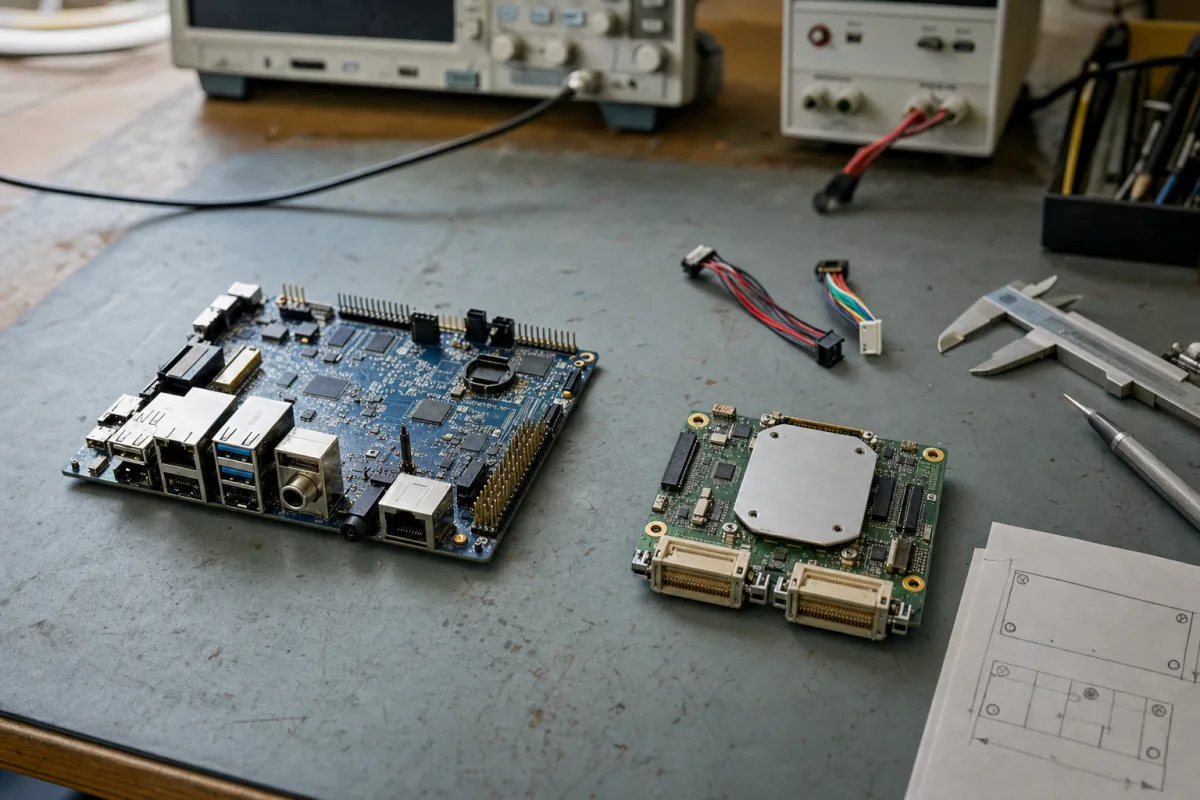
The usual argument for a custom board starts with five unused connectors. The purchasing team sees USB sockets, HDMI, headers, and an audio jack that the product will never expose, then asks why it is paying for them on every unit. That is a fair question. It is also an incomplete cost model.
A custom Android SBC can fit the enclosure, use locking connectors, integrate the exact display and radio, and remove adapter boards. In volume, it may produce a cleaner and cheaper product. The trade is that your company now owns more electrical validation, Android integration, compliance work, supply planning, and change control. An off-the-shelf board buys less design freedom but moves several risks to a platform that already exists.
The right decision comes from the finished product economics and the risk schedule, not from comparing two PCB prices.
Three Choices, Not Two
Most projects have a middle option: a supplier changes connectors, memory, I/O population, firmware, or outline while keeping a proven base design. We call this semi-custom, although suppliers use different terms.
| Route | Hardware change | Typical strength | Main limitation |
|---|---|---|---|
| Standard SBC | None beyond cables or adapter | Fastest start and lowest initial NRE | Mechanical compromise and recurring excess cost |
| Semi-custom board | Controlled changes to a proven platform | Better fit without reopening every design risk | Bound to the base PCB and supplier rules |
| Full custom SBC | New schematic, layout, BOM, and board validation | Maximum control over size, I/O, power, and unit BOM | Highest NRE, schedule, and ownership burden |
Semi-custom works well when the SoC, DDR topology, PMIC, and major high-speed paths remain stable. Removing HDMI, changing a terminal block, altering the PCB outline, or preloading a different Android image can be manageable. Moving LPDDR, changing the PMIC, adding PCIe, or rerouting MIPI and Ethernet is closer to a new design regardless of what the quotation calls it.
Compare the Cost of the Finished Assembly
Start with the cost inside the shipped enclosure. A standard board may require an HDMI-to-LVDS converter, USB touch cable, separate RS485 module, custom harness, mounting plate, and ten minutes of assembly. A custom board may integrate those functions but need a larger production fixture and a lower-volume PCB stack-up.
Use a break-even calculation:
break-even units = total custom NRE / savings per finished unit
If NRE is $90,000 and the custom assembly saves $18 per unit, the arithmetic break-even is 5,000 units. That is not yet the business break-even. Add the financing cost of the schedule, certification delta, engineering supervision, pilot scrap, spares, and ongoing software work. Then test the result against a conservative volume forecast, not the sales target.
These are planning ranges we commonly use for early discussion, not quotations:
| Development route | Indicative NRE | Time to a production release | Best fit |
|---|---|---|---|
| Standard board integration | $5k–$25k | 1–3 months | Low volume, early market test, flexible enclosure |
| Semi-custom platform | $20k–$80k | 3–7 months | Moderate volume with specific I/O or mechanics |
| Full custom ARM SBC | $80k–$250k+ | 7–12+ months | Stable requirements and meaningful lifetime volume |
Complex RF, multi-camera routing, high-speed memory, safety requirements, a new enclosure, or a major Android upgrade can push beyond these ranges. The assumptions should be written beside the number: number of revisions, BSP baseline, certification markets, sample quantity, and customer-supplied test application.
The deeper custom SBC cost breakdown separates board engineering, software, tooling, and lab work that are often combined under one NRE line.
Time-to-Market Is a Sequence of Evidence
An off-the-shelf board can boot on day one, but the product is not finished on day two. Display tuning, Android lockdown, thermal design, harnesses, regulatory tests, and the application still remain. Conversely, “PCB layout in six weeks” does not mean a custom SBC is six weeks from production.
A full custom schedule normally contains:
- requirements and architecture freeze;
- schematic design and peer review;
- PCB placement, routing, and design review;
- fabrication, assembly, and bring-up;
- Android boot, peripheral integration, and debugging;
- EVT fixes and a second build where necessary;
- DVT with enclosure, thermal, EMC, ESD, and reliability tests;
- PVT using production fixtures, firmware, and operators.
Several activities overlap, but unresolved inputs block them. The display cable cannot be frozen while the panel is changing. The thermal test has little value without the final enclosure and workload. Compliance testing before cable and power-supply selection is a pre-scan, not product approval.
When launch date dominates, a standard board or SBC-plus-display prototype often gets the application and user testing started while the team collects facts for the next hardware revision.
Hardware Risk Moves with the Boundary
With a standard SBC, the board supplier owns memory layout, PMIC sequencing, and base-board bring-up. Your team still owns the system: input protection, antennas, cables, display, enclosure, and thermal path. Full custom moves the board-level risks inside your project as well.
The risky areas on a modern ARM board are rarely the LED and UART. They are DDR layout and training, power sequencing and transient response, high-speed USB or PCIe, MIPI signal integrity, Ethernet clocks, eMMC boot configuration, thermal spreading, and pin multiplexing. A first prototype that boots does not close all of them. Run voltage and temperature corners, repeated cold boot, storage stress, simultaneous interface loads, and production-component variants.
Semi-custom is attractive precisely because it can preserve validated parts of this design. Ask which nets, layers, packages, and software components change. “Based on our standard board” has value only when the design reuse is specific.
Android Software Can Erase the Hardware Saving
Android follows the SoC vendor BSP, not the PCB shape. Reusing the same SoC family and vendor release reduces work, but a custom board still needs device configuration, device tree changes, display and touch drivers, audio routing, permissions, SELinux policy, factory tools, and update testing. Different Wi-Fi, camera, or secure elements can require HAL or vendor changes.
Decide who will maintain the product branch when the SoC vendor releases a security update or the chosen Android version reaches the end of the supplier’s support. Require a clean build process, release notes, source deliverables, signing-key ownership, and a regression test list. If GMS is part of the commercial plan, budget compatibility testing and licensing separately; building AOSP does not itself grant GMS.
The standard board wins when its existing BSP is genuinely maintained and close to your configuration. It loses some advantage when the shipped image is an old demo release that must be rebuilt anyway. Evaluate the Android and Linux platform tradeoff before paying for an Android customization that the product does not need.
Compliance Is for the Final Configuration
Existing SBC and radio reports are useful inputs. They do not make a new enclosure, cable set, display, antenna, and power supply automatically compliant. The EU treats the company placing the finished branded product on the market as responsible for the applicable assessment and technical documentation. FCC modular transmitter approval also has integration conditions for the host product.
A custom board may improve EMC by eliminating long adapters and exposing a better grounding design. It can also create a fresh failure through a switching regulator, display cable, or poorly referenced connector. Plan pre-compliance measurements during EVT and formal testing on DVT hardware. Keep margin for a filter, shield, cable, or layout revision.
The standard-board route can reduce radio and board documentation work. The full custom route gives better control over emissions and mechanical grounding. Neither removes final-product responsibility.
Supply and Change Control Decide the Long Game
An off-the-shelf board is a dependency on one board SKU. Ask for minimum manufacturing dates, PCN terms, revision policy, and whether substitutions preserve software and certifications. A custom design exposes the component list, but it also makes your team responsible for forecasting and approving alternates.
Full custom is strongest when the manufacturer has controlled alternates for memory, eMMC, PMIC, Ethernet PHY, and radio, and when the software supports those variants. In particular, embedded storage selection must preserve boot, endurance, and power-loss behavior across approved substitutions. Full custom is weakest when a low-volume BOM relies on spot-market parts to hit a target price.
Do not confuse ownership with portability. Having Gerbers does not mean another factory can immediately build the board; it also needs the approved BOM, fabrication notes, programming data, test fixture, calibration process, keys, and release history. Define these deliverables before the relationship becomes difficult.
Use a Decision Gate Instead of a Preference
We normally recommend a standard board when forecast volume is uncertain, launch speed matters, the enclosure can accommodate it, and the existing BSP meets the maintenance plan. Use semi-custom when a proven platform misses a small number of mechanical or I/O requirements. Choose full custom when requirements are stable, the volume-based saving is material, product life justifies NRE, and the team can fund at least one corrective revision.
Before approval, complete this short gate:
| Question | Proceed with full custom when… |
|---|---|
| Is the product definition stable? | Display, I/O, power, mechanics, OS, and markets are frozen |
| Is there real recurring value? | Savings or product differentiation exceed NRE with conservative volume |
| Is schedule protected? | EVT, DVT, PVT, and at least one re-spin fit before launch |
| Is software owned? | BSP delivery, maintenance, keys, OTA, and testing have named owners |
| Is supply controlled? | Critical parts, alternates, PCN, and forecast terms are documented |
| Can the product be validated? | Fixtures, environmental tests, EMC, and application stress are budgeted |
The most effective path is often staged. Ship a pilot product on a standard board if it meets the physical and commercial constraints. Measure application load, failures, assembly time, and customer demand. Those numbers turn the custom-board debate from opinion into an engineering decision.
Official References
Frequently Asked Questions
When does a custom Android SBC become cost-effective?
A custom board becomes attractive when it removes meaningful recurring cost or solves size, connector, power, display, lifecycle, or certification problems that a standard board cannot. The break-even point depends on NRE, annual volume, and the savings per finished unit.
How long does a custom Android SBC take to develop?
A realistic full-custom program often needs seven to twelve months or more from stable requirements through engineering validation, design validation, pilot production, and software release. A carrier or semi-custom revision can be faster when the compute platform and BSP remain unchanged.
Is a custom SBC always cheaper at volume?
No. It can reduce connectors, adapters, assembly time, and excess features, but lower purchasing volume, NRE, validation, scrap, certification, and ongoing BSP maintenance can offset those savings.
Can we prototype on an off-the-shelf SBC and switch to custom hardware later?
Yes, if the prototype uses the intended SoC family, OS branch, display path, and peripherals. Treat it as risk reduction, not proof that the later custom board will boot without new DDR, power, device-tree, thermal, and certification work.